

Joyful Journey Home — Drive Show
Not Enough Arms: The Vaal Triangle Chaplain Who Stands Where Nobody Else Will
13 July 2026 • Joyful Journey Home • 4pm Drive Show
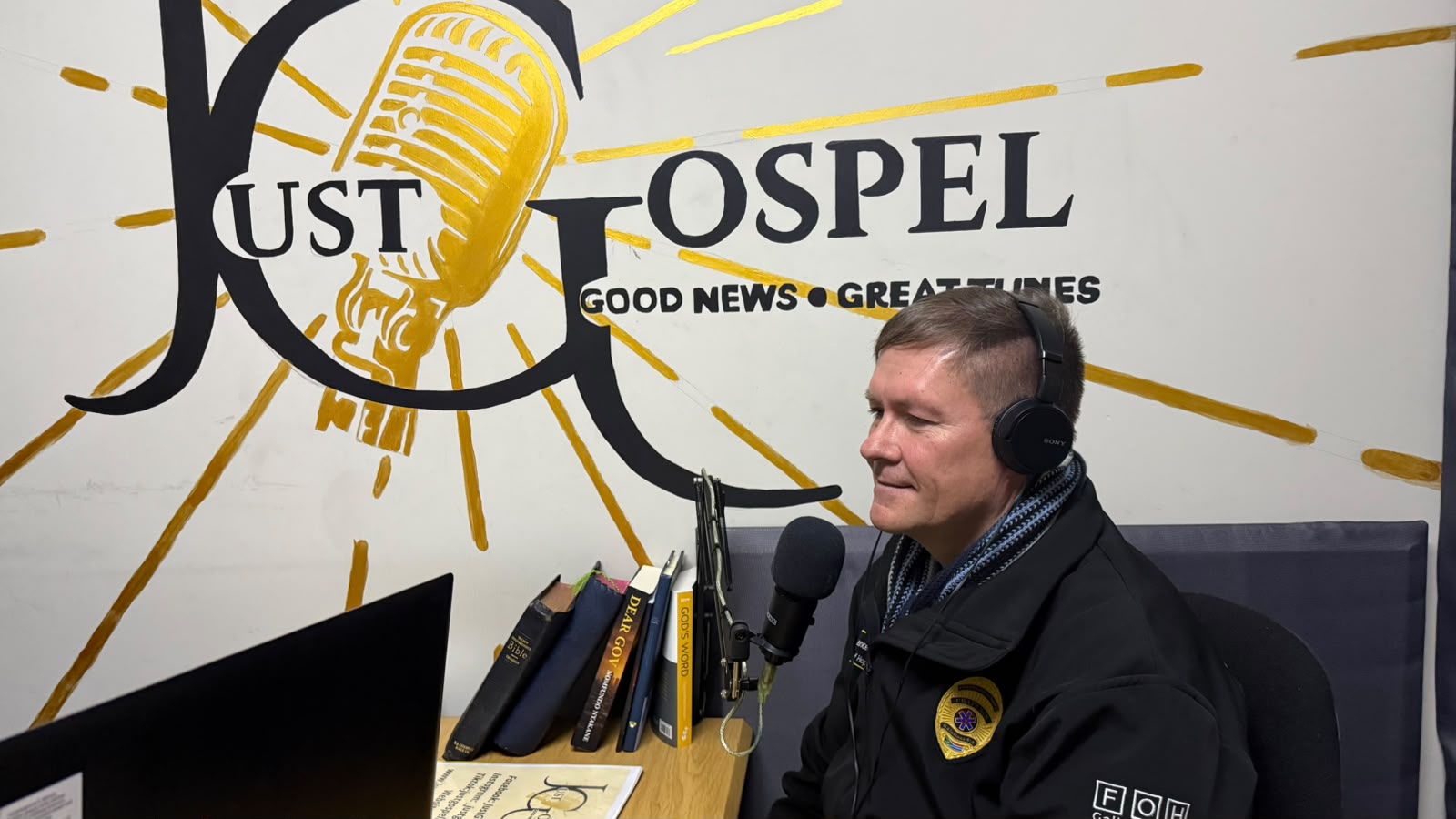
Lance Oosthuizen — Founder, Frontline of Hope Ministries — official chaplain for Midvaal Fire and Rescue. Three Rivers, Vaal Triangle. © JustGospel Radio 2026.
Lance Oosthuizen has spent 35 years inside emergency services. Started as a fireman, ended up more paramedic than firefighter, and is now an official chaplain for Midvaal Fire and Rescue. His ministry, Frontline of Hope, goes to crisis scenes in the Vaal Triangle: for families in the worst moments of their lives, and for the first responders nobody is looking after. For every emergency services worker who dies in the line of duty, four commit suicide. Frontline of Hope is trying to change that. One call at a time.
There was a fire truck, parked skew on the road the way they always are when a scene is too big to be orderly. Lance Oosthuizen walked up to it and turned the corner around the front chrome bumper. The first thing he saw was a fireman with his helmet off, crying against the metal. Eleven children had just been killed in a taxi collision on the back road near Midsteel. The fireman had nowhere to put it. Lance did not look away.
That is Frontline of Hope Ministries. A man who has held dead children in his own hands, who walked toward a weeping fireman on the worst scene in recent Vaal Triangle memory and stayed.
What the Ministry Actually Does
Lance Oosthuizen founded Frontline of Hope Ministries out of Three Rivers, Basie Street, ten minutes from the JustGospel studio in Duncanville. He is one of three official chaplains for Midvaal Fire and Rescue alongside Jan Combrink and Enoch. When a call comes in, the sequence starts before anyone leaves the building.
“Prayer is an absolute must,” Lance said on Joyful Journey Home. Before every callout, whether he goes with his wife Kim or with a trauma support mediator from his team, they pray. “You’re entering a dark domain of crisis and heartache and raw emotions. We need to be protected as well.”
On scene, he teaches every mediator the same three things: bring the presence of God, enter with the characteristics of Jesus, be led by the Holy Spirit. It sounds theological. It is. It is also the most grounded thing you can bring to a mother standing twenty metres from a crime scene tape who has nobody beside her.
When Frontline of Hope arrives they go first to the most senior officer on scene and ask permission to work. The crime scene is the police’s territory. What the ministry is there for is the family who cannot process what is happening, and the first responders who are quietly carrying it alongside them.
“What happens next? Where do we go now? Those are the questions we can answer.” — Lance Oosthuizen, Frontline of Hope Ministries
They anchor people back to reality. Explain what happens to the body, what the state mortuary process looks like, what the next practical steps are. Give people something concrete to hold. Once there is trust, families start to open up about the person they lost, about their life, about what comes next. Everything in the counselling that follows, Lance said, comes easier once that foundation is laid.
The Gap Between the Family and the Frontliner
The police officer on that scene has been at three others this week. The paramedic who arrived first is twenty-two years into a career that gave him no training on what accumulates when you do this repeatedly. Nobody talks about that part.
Standard PTSD follows one event. Frontliners are not dealing with one event. They are dealing with continuous exposure, call after call, shift after shift, for the length of a career. Lance calls it continuous exposure post-traumatic stress disorder, and it fills a person differently than anything a standard counsellor is trained to meet.
“We are taught to suppress,” Lance said. “That’s why we turn to alcohol. To pornography. To procrastination, switching off, being worth nothing to the family at home. Not because they don’t love their family. Because there is simply too much inside.”
For every emergency services worker who dies in the line of duty, four commit suicide. One to four. A worldwide figure. And the four rarely make headlines.
The shooting or the accident gets the headline. The fireman who spent fifteen years pulling bodies from vehicles and one day could not carry another one, nobody reports that. Lance wants that statistic known. Frontline of Hope exists, in part, because of it.
Pierre, one of the ministry’s trauma support mediators, was recently at a call where a child had died. When the forensic pathology team arrived, Pierre offered one of them a cup of coffee and asked how he was doing. The man’s eyes filled with tears. That was all it took.
Cowboys Don’t Cry
Lance grew up in the old culture of emergency services. You did not show weakness. You sucked it up and came back ready for the next shift. He is honest that this culture did damage in his own life. He does not dwell on the detail. He gives you where he ended up: an encounter with Jesus that changed his understanding of where hope comes from.
“The younger generation actually do open up,” Lance said. “It’s the men and women conditioned for decades to carry it alone who concern me most.”
For his team, the support structure is deliberate. Debriefs after every call. One-on-ones when someone is not coping. Referrals to Christian counsellors Jan Combrink and Yolande Coetzer when it goes deeper than the team can hold. Jan was a policeman. Yolande’s husband was a policeman. They know the world they are counselling into.
Lance’s wife Kim is his own foundation. “She was there,” he said. “Even in the four years when I was not there.”
The Bridge
One scene has stayed with Lance. A young man on top of a bridge, ready to jump. The police had cordoned the area. Nobody was getting close.
Lance prayed before he walked up. He did not arrive with a script. He introduced himself and said he just wanted to help. The young man told him to stay back. So Lance stayed and talked. Not about the crisis. About the person. About who that man was behind the moment he was standing in.
“I wanted to get to know this guy,” Lance said.
The young man started to relax. He turned toward Lance instead of toward the traffic below. When he shifted his weight and moved one leg back over the barrier the officers behind him moved in and brought him to safety. Then there was time for a real conversation. Time for hope to find a foothold.
Lance did not call it a technique. He called it relationship. “Just that simple caring thing, how are you, it moves a person’s emotions in a different direction.” John 10:10 is where he roots it. The enemy comes to steal, kill, destroy. Isolation is the weapon. That is the exact place Frontline of Hope walks into.
The Frontline Begins at the Church Door
Lance’s tagline: the frontline begins when you walk out the church door.
He does not mean only chaplains and paramedics. He means the woman who knits blankets for people who have none. The neighbour who shows up with food. The person who stops at a hospital nursing station and asks a nurse, when last did somebody pray for you?
“You can be the old aunty who knits a blanket for somebody who doesn’t have one, in the name of Jesus. That’s frontline.” — Lance Oosthuizen
The church is a pit stop. You come in, your cup is filled, you receive the Word, you get equipped. Then you walk out the door and the actual work starts. Out there in the Vaal Triangle, in fire stations and hospital corridors and on the N1.
Billy Graham said it: go spread the gospel, and sometimes use words. Lance says it from 35 years of standing at scenes where words are not the first thing needed. Just being there is also gospel.
How to Support Frontline of Hope Ministries
Prayer first. Pray for the chaplains absorbing what first responders carry. Pray for the fuel, the coffee, the operational costs of keeping this ministry on the road. Pray for the police officer, the paramedic, the firefighter who will clock in tonight and has never had anyone ask how they are doing.
Frontline of Hope also runs on donations. Pierre put it straight: charity doesn’t put bread on the table. If you want to sponsor coffee and cups for crisis scenes, or contribute toward what it costs to keep showing up, contact Lance directly.
And if you want to take Lance’s challenge seriously, go to your nearest fire station. You do not need to understand what they carry. Just show up. Be Aaron to Moses. Hold up their hands.
Contact Frontline of Hope Ministries
Lance Oosthuizen
📞 082 809 2141
🌎 Search Frontline of Hope Ministries on Facebook and on the web
Based in Three Rivers, Basie Street, Vaal Triangle