

 JustBusiness · Tuesdays 7–8pm · JustGospel Radio
We Will Speak For You
When You Cannot
Geniene Preston built an NFC tag that tells first responders who you are when you can't tell them yourself. She did it at 66. Fifty years after they told her she wasn't wired for it.
In 1975, a company called Fonseal and Pritchard sat Geniene Preston down after a programming aptitude test and told her — out of the whole class — that she should try landscape gardening. Not computers. Never computers.
She is 66 years old now. Her app shipped to Google Play and the App Store two days before this conversation with Lindi Tshabangu happened on JustGospel Radio.
Fifty years is a long time to prove somebody wrong. She says she is, and I quote, "so flippant proud" of herself. She earned it.
The Brain They Said Was Wired Wrong
She spent the decades in between doing other things. She was a secretary, by her own account a bad one, at the point in history when computers were still considered equipment for buffs. The computer eventually became mandatory. She grew through the ranks into programming — the very thing they had ruled her out for — and eventually ended up in publishing, then back in radio. She and Lindi have known each other for over 25 years. They did Radio 2000 together, talking between cricket breaks, learning to compress five minutes of information into 30 seconds so tight you could feel it.
She lost her daughter. That's the moment the timeline turned. When you lose a child, she says, you stop waiting for the right moment. You have one day. You either use it or you don't.
"If you can make a difference in somebody's life, that for me is my million-dollar payment. I don't care that Elon Musk has got 16 gazillion million rand. I can't take his money with me."
Geniene Preston · JustBusiness · JustGospel RadioThe last piece was AI. She named hers Todd. She says she asked Todd the same question 35 times and he never once got frustrated — he just kept answering differently until she understood. She wrote a book about AI. Then she used it to do what she had been trying to do since she was 16: build software. It took her six months. She slept two or three hours a night. A developer would have done it in two months. She wasn't afraid of the time.
What Started It
Two things. Her sister lives in an old age home. People with Alzheimer's and dementia walked out of the gate and turned up weeks later at Helen Joseph Hospital. Nobody knew who they were. The people who found them didn't know. The patients couldn't say. Her sister couldn't locate them until they were already in a hospital bed far from home.
The second thing was her husband. He had a stroke some years ago. He still rides a motorbike. He takes warfarin — a blood thinner. If he goes down on the road and a first responder gives him the wrong treatment, it could kill him. She had Lifeworld 360 tracking him. She could see his location on her phone. She still had to get in her car and drive to him. By the time she arrived, someone had already tried to help, and they wouldn't have known about the warfarin.
She looked at taxi accidents where people lay scattered on the road and nobody knew who any of them were. She read about a woman knocked over at the end of a road whose face was so covered in blood that facial recognition wouldn't work on her phone. Nobody could unlock it. Nobody could call her family. The phone that held every piece of information about her was locked.
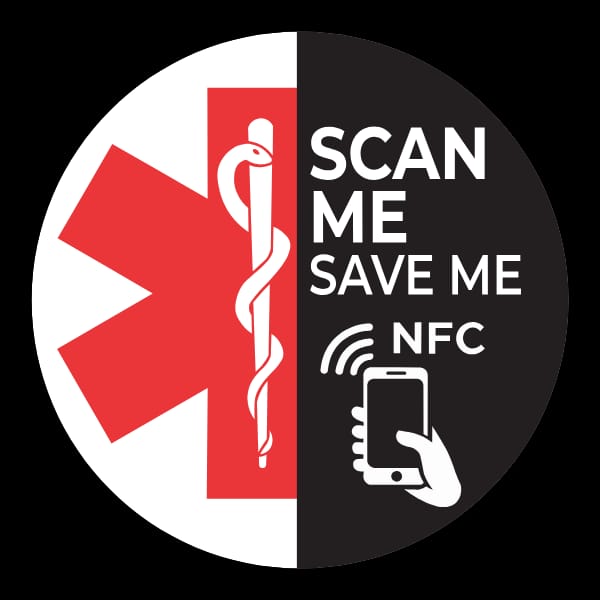
That's when Scan Me Save Me became a thing.
How It Works
You wear a small NFC chip — on a bracelet, a watch, a necklace, a helmet sticker, or a license disc on your car windscreen. You use the app once to write your details onto the chip. Name, date of birth, blood type, medical conditions, disabilities, allergies, emergency contact. Then you wear it and forget about it.
A medic arrives at an accident scene. He taps his phone on your wrist. Your information comes up. No internet. No signal. No app required on his end — it reads in native mode, the same way any NFC-equipped phone reads any chip. If you're face-down in a ditch in Cradock with no signal, the information is still there.
The information is not saved on Geniene's servers. Not on the reader's phone. Not anywhere except the chip on your wrist — written there by you, worn there by you, readable only when someone puts a phone to it.
How Scan Me Save Me stores your dataShe's thought about the edge cases. Don't put your address on the tag — if a bad actor finds you incapacitated, you don't want him knowing where you live. Don't fill in the questions where the answer is no — if you skip a field, the medic reads the absence. The chip holds between 500 and 800 characters. Use them for the things that could kill you if the paramedic doesn't know.
The fields include disability type — deaf, blind, autism — with a second level for specifics. An epilepsy field asks which kind and what the triggers are. There's a COVID vaccination field because paramedics flagged that COVID appears to have left some people with changed medical profiles. There's a DNR option. Organ donor status. Medication. Food allergies. All of it readable in under ten seconds by anyone with a phone.
needed Reads anywhere, any phone, native NFC
Scan Me, Pay Me
While she was building the medical product, she thought about car guards. South Africa stopped carrying cash. The car guard stands in the sun for eight hours and goes home with nothing because nobody had a R5 on them. She built a companion product — a wristband linked to the guard's bank account. You tap your phone to his watch. Your screen opens Ozow. You pay from your own phone. Your card details don't go anywhere near his device. The money lands in his account. The watch costs R100, once. No subscription. Because, she says, why would you take a subscription from someone who earns two rand?
The watch can be stolen. The money is already in his bank.
"95% of this country just wants to raise our kids, be kind to one another, and have a happy life. That's the principle of Ubuntu. That's why I started this."
Geniene Preston · JustBusiness · JustGospel RadioWho She's Still Trying to Reach
The Pingo riders. The Mr Delivery cyclists on a clock that gives them no business being in traffic that fast. The Alzheimer's patient who walked through the gate. The tourist who arrived at OR Tambo and got robbed before they left the airport — wallet gone, bag gone, no ID, family overseas with no way to know where they are. The jogger who doesn't carry anything except a phone that will probably be stolen. The child going to school in a taxi.
She's trying to get insurance companies and medical aids to give the tags away free. She's trying to reach first responders — paramedics, tow truck companies, firefighters — so they know what the tag looks like and where to look for it. She's trying to get the helmet stickers onto every food delivery rider in the country. So far, the riders' companies won't talk to her. She says it plainly and moves on.
Website: www.scanmesaveme.com
App: Search "Scan Me Save Me NFC" on Google Play or the Apple App Store
Call / WhatsApp: 082 610 7380
Delivery: R49 via Pudo, nationwide
Wearables: Bracelet, watch, necklace, helmet sticker, vehicle license disc — order through the website under Wearables
First responders, insurance companies, medical aids, and fleet operators looking to partner — she wants to hear from you. The license discs for vehicles are available for sponsorship. The tags are a once-off cost. There is no subscription.
Geniene Preston
Founder · Scan Me Save MeDeveloper, author, and broadcaster. Told at 16 she wasn't wired for computers. Became one at 66. Scan Me Save Me is her answer to the question she couldn't stop asking: when someone can't speak for themselves, how does anyone know who they are?
Lindi Tshabangu
Host · JustBusiness · JustGospel RadioLindi hosts JustBusiness on JustGospel Radio, Tuesdays 7–8pm — a space for Kingdom entrepreneurs doing work that matters. She and Geniene go back over 25 years, to Radio 2000 and cricket break bulletins. She has not got less sharp since then.