
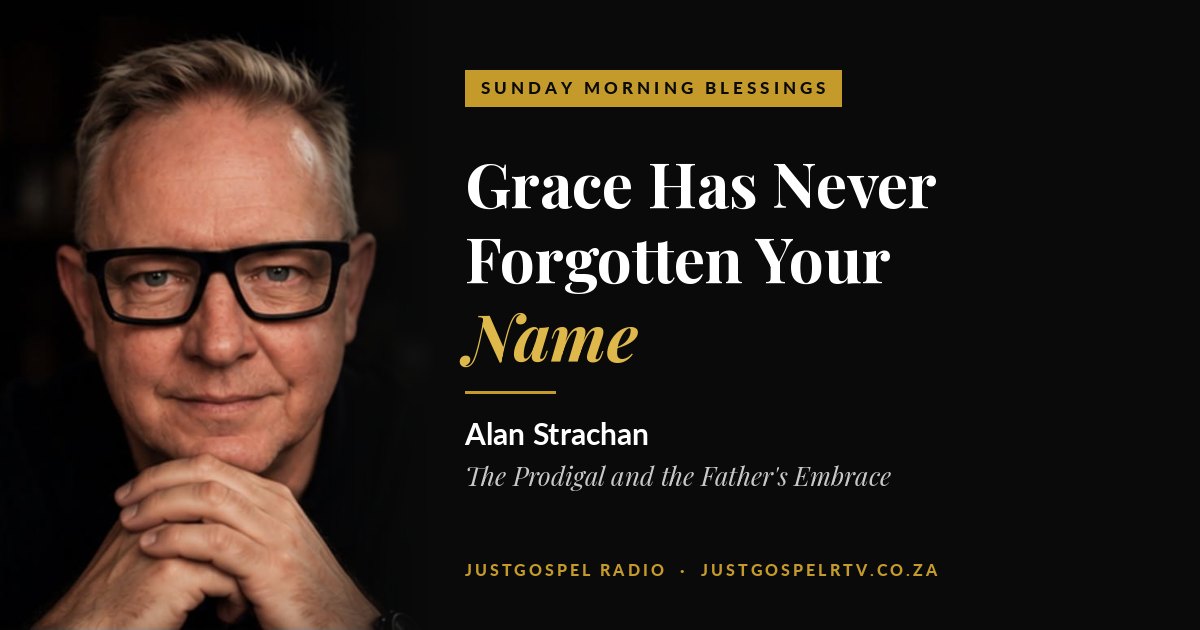

Grace Has Never
Forgotten Your Name
Addiction therapist Alan Strachan on trauma, the neuroscience of praise, and the 40-day road back to the Father's embrace.
At five years old, Alan Strachan sat in the family doctor's rooms and asked one question: how do we help Mommy? The doctor took his small hand and told him there was no medicine for that. It took Alan forty years, a rehab, three degrees and one collision with God to find the answer. He has put all of it into one book.
We came out of the long Heritage weekend and straight into one of the heaviest, most hopeful hours Sunday Morning Blessings has had this year. Alan is an addiction therapist with 21 years in the field. He consults to White River Manor, a private treatment centre in Mpumalanga for addiction, trauma and burnout founded in 2015, and to the White River Recovery Centre. He has worked across seven centres, helped open several faith-based rehabs around South Africa, and now runs Alan Vaughan Consulting.
None of that is where his story starts, though. It starts in a house that was not safe.
A Mother Who Drank, a Father Who Hit
Alan's mother was an alcoholic. His father was violent. He grew up in the kind of noise children learn to read before they can read books: the arguments, the beatings, the constant scanning for what mood the house was in. He went to church hoping prayer would fix his mom. He went to doctors. Later he went to a psychologist. Every well-meaning adult had a single answer. Take this pill. Pray this prayer. Do this one thing and you'll be fine.
He wasn't fine. At thirteen a friend handed him his first beer, and for the first time the noise inside him went quiet. "It was like taking a headache tablet," he told Carlett. The pain and the shame just switched off. That was the beginning of a long road that ran through South African sports culture, drinking, cocaine, depression, and eventually a rehab where he woke up, as he puts it, in the pigsty.
In 2005 he went for treatment. Something happened there that he still describes as God colliding with him. He felt called to volunteer at the centre. Within six months they offered to pay for him to study. Within eighteen months he was studying psychology, theology and neuroscience. He has never stopped.
Why am I qualified? Because I was disqualified.
Alan Strachan, the self-described “redeemed skabanga”Addiction Is Not the Problem
This is the part of the conversation you need to hear, especially if you love someone who can't stop.
Addiction is the visible adaptation.
It's not the problem.
Alan Strachan on Sunday Morning Blessings
Alan illustrated it with a story that made the studio go quiet. A little boy falls in the garden and cuts his leg. He runs to his mother. She picks him up, kisses it, tells him it's okay. A month later he falls again and runs to his father, who says: don't cry. A few weeks after that he falls a third time, runs towards the house, rounds the corner and sees his dad. He stops. He swallows it. And somewhere in that swallow he decides emotions are weakness.
Nobody beat that child that day. Nothing dramatic happened. But he disconnected from something true in himself to survive, and he built a little wall. Rugby makes the wall thicker. School makes it thicker. The report card with four A's, two B's and one D teaches him he is only as good as his performance. Twenty years later he has no idea why a drink makes him feel like himself again. "It's not something wrong with him," Alan said. "He had to survive, and he created his strategy."
Those small moments are paper cuts. Abuse and molestation are gashes. Either way, the child adapts, and addiction is simply the adaptation you can finally see.
Carlett was honest on air about what that picture did to her. It has been a year of blow after blow, she said, paper cut on paper cut, and never enough time to stop and deal with any of it before the next one lands. Alan didn't soften it. When we push things down, he said, we are putting a blemish in the spring the heart flows from, and it compounds. It eventually comes out as stress, loneliness, fatigue and burnout.
Keep thy heart with all diligence; for out of it are the issues of life. Proverbs 4:23 (KJV)
His picture for it was a splinter. You barely notice it going in. Then it festers, turns septic, swells, and suddenly everyone wants to treat the swelling. The anger, the anxiety, the depression, the drinking. No, Alan says. That's the symptom. You have to go in and get the splinter out.
The 5A Adaptation Model
That is what his framework does. He calls it the 5A adaptation, and it works back through the layers of a life rather than just attacking the behaviour on top.
It begins with the need: the boy needed to be seen, comforted and made safe. When the need goes unmet, he disconnects, and in that disconnection a belief takes root, something like "I'm weak" or "I'm not good enough." That belief is the real splinter. Over it he builds a mask. Then comes the culture of addiction, which Alan talks about with real insight. The beer crowd, the whisky crowd and the wine crowd each have their own dress code, music, cars and rules, and a young man quietly makes ten thousand small choices to fit in, because that group gives him the belonging his family didn't.
Last comes the body itself, and here Alan got wonderfully practical. Picture your body as a factory with forty workers, your neurochemicals, all communicating. Your brain is the boardroom, with around 105 parts that should be talking to each other. Addiction knocks out roughly eight of those workers. Anyone who has run a business knows what a day with missing staff looks like: nobody answers the phone and everything is chaos. The boardroom stops communicating, executive function goes, and survival emotions like fear and anxiety take over the building. Every time you hurt and drink and feel better, the brain writes that down as a rule.
Praise Is Not Just Spiritual. It's Neurological.
What moved me most in this hour was how Alan keeps finding scripture waiting at the end of every psychological tool. He studied at the Institute of Christian Psychology under Professor Nicolene Joubert, where the first task was to throw out every theory that reduces a person to behaviour and doesn't fit body, soul and spirit. What survived, he says, turned out to be principles God had already written down.
Gratitude is one of the first things taught in addiction recovery. Scripture tells us to enter His gates with thanksgiving and His courts with praise. When you are stressed and hurting, you are living in the limbic system, the survival brain, flooded with cortisol. When you praise, you shift up into the thinking brain, where the chemicals of wellbeing live. Cognitive therapy tells you to challenge and change your thinking. Paul told the Romans to be transformed by the renewing of their minds.
And be not conformed to this world: but be ye transformed by the renewing of your mind. Romans 12:2 (KJV)
Alan is careful here. There is a lot of psychology Christians should reject, he says, and theology has to stay in first place with everything else plugging into it. But the tools that work, work because they line up with something God designed. His phrase for it was baking a cake without an oven. You can have all the right ingredients and still need something to bring it together.
Then Carlett said the thing she thought she might not be allowed to say on air. We need to become addicted to Jesus. Alan didn't flinch.
I moved from cocaine to Jesus. When I worship Him, I feel peace. When I read the Word, I feel presence. He meets attachment: I belong, I'm accepted, I'm loved.
Alan StrachanThere's a deeply personal edge to it too. Because his own father was violent, "Father" was a dirty word when Alan first came to faith. People told him to worship the Father and everything in him said no. So he went around the mountain. He called God Creator. Provider. And slowly the revelation of the Father came. Today he tells clients that God stores their tears in a bottle, and that he can't wait to get to heaven and ask to see his.
The Book: 40 Days on the Road Home
The Book
The Prodigal and the Father's Embrace
A 40-Day Journey of Grace, Healing and Restoration
Forty years of hard-sweated knowledge compressed into forty days. Every day gives you seven habits to practise: morning exercises, one tool to master during the day, evening reflection in your journal, and a closing prayer to seal it. Scripture, psychology and neuroscience working together, and the focus never on the addiction itself but on whatever is keeping you from living as a child of God.
The cover shows a path through a forest with sunlight breaking through the trees, and that's exactly the point. Recovery, Alan says, is not a destination. It's a walk. The prodigal came to his senses in the pigsty, but he didn't wake up at his father's gate the next morning. There was a road. Alan calls addiction Egypt and recovery the wilderness, the place where you want to go back and moan every step, until the tools start to take hold.
Day one is called the sacred pause. You're anxious. You stop and breathe, which resets your biology. As you breathe you reflect on one line: be still and know that I am God. Now your thinking brain is speaking peace to your emotional brain. And you practise what psychologists call metacognition, thinking about your thinking, and discovering that not every thought needs to be obeyed. That evening your journal asks where you felt pulled away today, which thought pulled you, and how many times you had to reset.
Carlett pushed back: that sounds like a lot of work. Alan's answer landed. People in active addiction spend three to six hours a day drinking. They are already doing the hard work, just with no solution at the end of it. A wise man builds his house on the rock one brick at a time, and he builds it because he can see the house. "You've come to a rehab-it," he tells clients. The old habit was: when I hurt, I drink. The new one is: when I hurt, I go to the One who is close to the broken-hearted.
The LORD is nigh unto them that are of a broken heart; and saveth such as be of a contrite spirit. Psalm 34:18 (KJV)
“Grace Has Never Forgotten Your Name”
That line is printed on the book, and when Carlett asked what it meant to him, Alan had to stop for a moment. Most people who arrive in recovery, he said, carry an enormous weight of shame and have lost any sense of who they are. But Ephesians says we were chosen before the foundation of the world. And in the parable, the father watched the road every single day.
God doesn't see your sin. He sees a son, a child. He's calling your name. God is sitting every day and whispering a million names. Sam. Kevin. Philip. Come home. I've not forgotten you.
Alan StrachanThe father in Luke 15 doesn't say, there's my bad son. He says, my son was lost and now he's found. That's grace. And if you are reading this in your own far country right now, that is the whole message of this hour.
Where to Get Help
SADAG Substance Abuse Helpline · Free · South Africa
If you or someone you love is struggling with alcohol or drugs, pick up the phone. You do not have to have it figured out before you call.
Alan was clear that addiction affects people very differently. His team starts by assessing you. In the early phases you may be able to recover at home with support. If it has gone further, he says, you need proper treatment, sometimes six months, sometimes a year. His team works with medical aids where possible, and because not everyone can afford rehab, Alan has built a network of churches and organisations that run outpatient programmes and support groups.
He also sounded a warning worth repeating. There are too many unregistered, fly-by-night rehabs in this country, and his teams regularly have to undo damage done by people who were given false information. The centres he works with are registered with the Department of Health and the Department of Social Development. Check before you commit, and if you're not sure where to go, email him and he'll point you to the right place for where you are right now.
And there's more coming. Alan is working on a year-long programme and a pastoral guide, and his former professor wants him to train pastors in this framework. Within about nine months he hopes to launch a phone-based programme so people can carry the tools in their pocket with his team on the other end. Carlett has already asked him to come back when it launches. We'll hold him to it.
Addiction, he said in his parting words, is not a simple disease. It is social, psychological and biological, and it takes all three pillars rebuilt together, new friends and community, a secure identity and values, and a body that is fed, rested and moving, to bring someone all the way home. A pill alone won't do it. A prayer said once won't do it. A daily walk with the Father, with the right tools in your hands, will.
Quick Answers
Who is Alan Strachan?
A South African addiction therapist with 21 years of experience. In recovery since 2005, he studied psychology, theology and neuroscience, has worked across seven treatment centres, consults to White River Manor and White River Recovery Centre in Mpumalanga, and runs Alan Vaughan Consulting.
What is The Prodigal and the Father's Embrace?
A 40-day journey of grace, healing and restoration for people struggling with addiction, built on the parable of the prodigal son. Each day includes seven practised habits combining scripture, psychology and neuroscience.
What is the 5A adaptation model?
Alan's framework for understanding addiction as an adaptation rather than the root problem. It traces unmet childhood needs, the disconnection and false beliefs they create, the mask a person builds, the culture of addiction they enter, and the changes addiction makes to the brain and body.
How do I contact Alan Strachan?
Through alanvaughan.co.za or by email at help@alanvaughan.co.za. For immediate help in South Africa, call the SADAG Substance Abuse Helpline on 0800 12 13 14.
Alan Strachan
Addiction Therapist · Author · Alan Vaughan Consulting
Alan Strachan entered treatment for addiction and depression in 2005 and has spent the 21 years since studying psychology, theology and neuroscience and working with tens of thousands of people across seven treatment centres. He consults to White River Manor and White River Recovery Centre in Mpumalanga, has helped establish several faith-based rehabilitation centres in South Africa, and is the author of The Prodigal and the Father's Embrace: A 40-Day Journey of Grace, Healing and Restoration. His practice, Alan Vaughan Consulting, carries his middle name.
Website: alanvaughan.co.za
Email: help@alanvaughan.co.za